
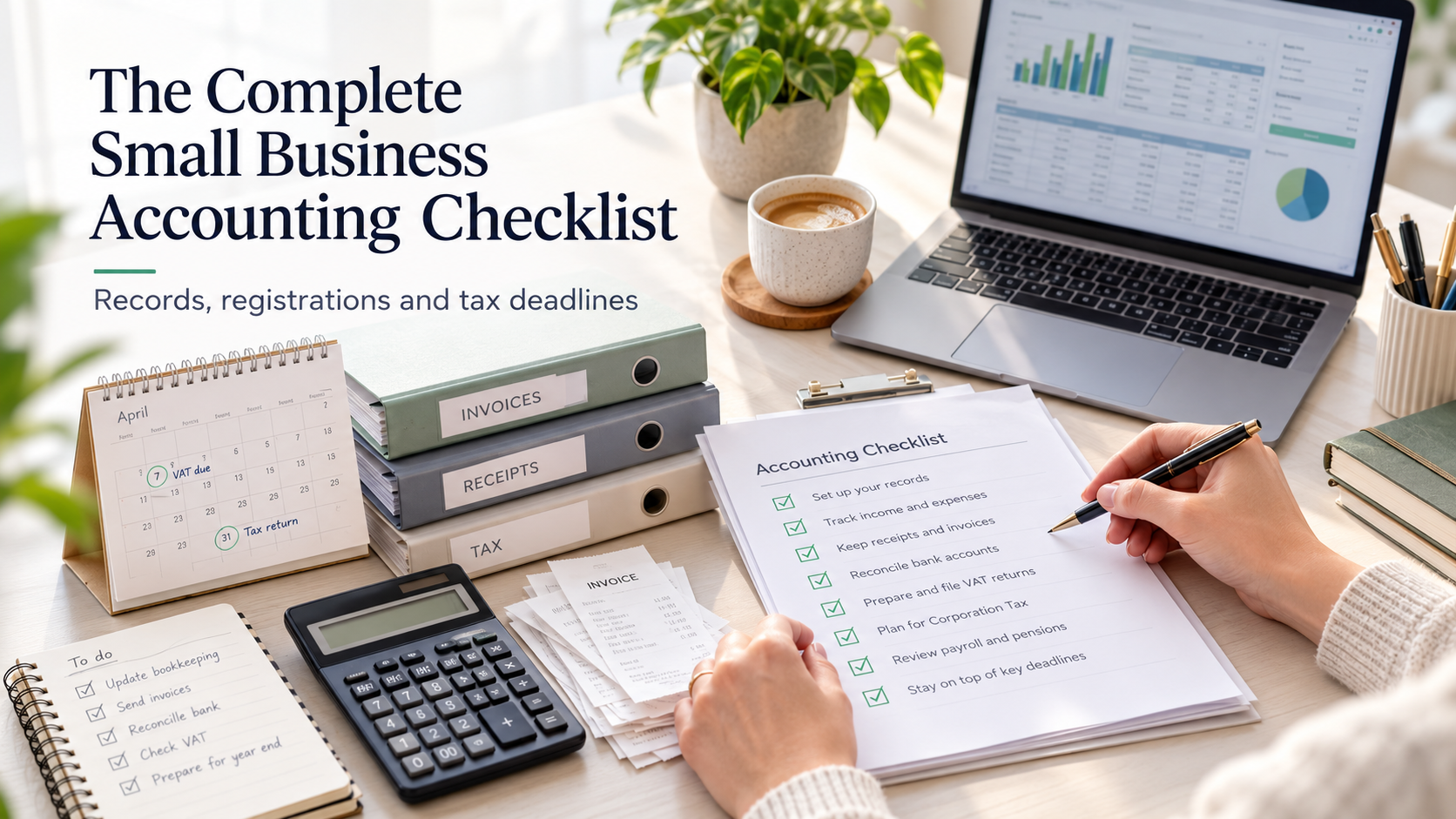
The Complete Small Business Accounting Checklist
A practical accounting checklist for UK small business owners. From registering your business and keeping accurate financial records to managing VAT, payroll, tax returns and filing deadlines, this guide covers the essential accounting responsibilities for sole traders, partnerships and limited companies.
7 MIN READ | SMALL BUSINESS GUIDES
Your practical guide to accounting records, registrations, tax returns and important deadlines
Running a small business means juggling many responsibilities. Alongside looking after customers, managing suppliers and growing your business, there are accounting, tax and record-keeping requirements that need regular attention.
Whether you're starting a new business or have been trading for years, knowing what needs to be done — and when — can help you stay organised, avoid penalties and make better financial decisions.
At Craigerne Accountancy, we've created this practical checklist to help small business owners understand their key accounting and tax responsibilities.
You don't necessarily need to do everything yourself, but it's important to understand what your business is responsible for.
Who is this guide for?
This guide is designed for UK small business owners, including:
Sole traders and self-employed individuals
Partnerships
Limited companies
Tradespeople and contractors
Consultants, freelancers and professional service businesses
Independent retailers and other small businesses
Not every requirement applies to every business. Your obligations will depend on your business structure, turnover, activities and whether you employ staff.
Do you own rental property?
Landlords and property investors have some different accounting and tax responsibilities, including the treatment of rental income, mortgage interest, allowable expenses and property disposals.
We cover these separately in our Complete Landlord Accounting and Tax Checklist.
If you operate a business and also receive rental income, both guides may be relevant.
Part 1: Getting started — registrations and setup
When starting a business, there are several important decisions and registrations to consider.
Use this checklist to make sure you have the foundations in place.
1. Choose your business structure
Decide whether to operate as a sole trader, partnership or limited company.
Understand the tax and reporting obligations of your chosen structure.
Consider whether your business structure remains appropriate as the business grows.
A sole trader operates a business personally, whereas a limited company is a separate legal entity with its own reporting responsibilities.
Neither structure is automatically better. The right choice depends on factors including profitability, risk, administration and how you intend to take money from the business.
2. Register your business
Sole trader: Check whether you need to register for Self Assessment with HMRC.
Partnership: Register the partnership and arrange the necessary partner tax registrations.
Limited company: Incorporate the company with Companies House.
Limited company: Ensure HMRC is notified when the company becomes active for Corporation Tax.
Check whether any industry-specific registrations or licences are required.
Sole traders generally need to register for Self Assessment if gross trading income exceeds £1,000 in a tax year, although other circumstances may also trigger a filing requirement.
Where registration for Self Assessment is required, the usual deadline for notifying HMRC is 5 October following the relevant tax year.
3. Set up your finances
Open a dedicated business bank account.
Choose how you will issue invoices and collect payments.
Set up an accounting or bookkeeping system.
Establish a method for keeping receipts and supporting documents.
Consider setting aside money regularly for future tax bills.
Decide whether you need professional accounting or bookkeeping support.
For limited companies, keeping company funds separate from personal funds is particularly important.
A separate business account is also strongly recommended for sole traders, even where it is not legally required.
Craigerne tip: Good accounting habits are much easier to establish at the beginning than to introduce after several years of trading.
4. Check VAT and payroll requirements
Determine whether VAT registration is required.
Consider whether voluntary VAT registration may be beneficial.
Register for PAYE if required before paying employees or directors.
Check workplace pension obligations if you employ staff.
Consider whether Making Tax Digital affects your business.
The compulsory VAT registration threshold is currently £90,000 of taxable turnover, generally assessed over a rolling 12-month period. A separate test applies where taxable turnover is expected to exceed the threshold in the next 30 days alone.
Part 2: Keeping the right accounting records
Accurate financial records are one of the most important parts of running a business.
They help you calculate tax correctly, understand business performance and provide supporting evidence if HMRC requests information.
1. Keep records of business income
Sales invoices issued to customers
Payments received from customers
Cash sales and receipts
Credit notes and refunds
Other business income
Outstanding customer balances
Make sure you can identify what income relates to, when it arose and whether the customer has paid.
2. Keep records of business expenditure
Supplier invoices and receipts
Materials and stock purchases
Rent, utilities and premises costs
Business insurance
Software and subscriptions
Marketing and advertising costs
Vehicle and travel costs
Professional fees
Equipment and other asset purchases
Staff wages and related costs
Remember that not every business payment is automatically tax deductible.
Some expenses may be restricted, partly private or treated as capital expenditure.
3. Maintain other important financial records
Depending on your business, you should also retain:
Business bank and credit card statements
Loan agreements and repayment schedules
Stock and inventory records
Records of assets owned by the business
VAT records, where applicable
Payroll and pension records
Records of money introduced or withdrawn by owners
Director's loan account records, where applicable
Dividend documentation for limited companies
How long should you keep your records?
For self-employed individuals, records generally need to be retained for at least five years after the 31 January Self Assessment filing deadline for the relevant tax year.
Limited companies generally need to retain accounting records for six years from the end of the relevant financial year.
Longer retention periods may apply in some circumstances.
Craigerne tip: Use a consistent digital filing system and capture receipts when expenses occur. A photograph or digital copy is often much easier to locate than a paper receipt several years later.
Part 3: Weekly and monthly accounting tasks
Many accounting problems arise not because business owners fail to understand their obligations, but because bookkeeping is left until the year-end.
A simple routine can help prevent this.
1. Weekly bookkeeping checklist
Issue invoices for work completed.
Record customer payments received.
Record new business expenses.
Save receipts and purchase invoices.
Check outstanding invoices and chase overdue customers.
Keep cash transactions up to date.
For a business with relatively few transactions, these tasks may only take a short time each week.
2. Monthly accounting checklist
Reconcile bank accounts with your bookkeeping records.
Check customer and supplier balances.
Review monthly income and expenses.
Monitor cash flow and upcoming payments.
Review profitability.
Set aside money for tax liabilities.
Check turnover against the VAT threshold.
Review payroll, pension and PAYE obligations where applicable.
Check for any upcoming filing or payment deadlines.
Business owners should also keep an eye on whether the business is making a profit, not simply whether there is money in the bank.
A healthy bank balance does not necessarily mean that all future tax bills and other liabilities have been provided for.
Part 4: VAT and Making Tax Digital
1. VAT responsibilities
VAT registration brings additional bookkeeping and reporting responsibilities.
If your business is VAT registered:
Issue invoices with the required VAT information.
Record VAT charged on sales.
Record recoverable VAT on purchases.
Maintain the required digital records.
Use Making Tax Digital-compatible software.
Submit VAT Returns when due.
Pay VAT owed to HMRC by the relevant deadline.
Review whether your chosen VAT scheme remains appropriate.
Most VAT-registered businesses submit VAT Returns quarterly.
The usual filing and payment deadline is one calendar month and seven days after the VAT accounting period ends.
Even if no VAT is payable, a VAT Return will normally still be required.
2. Making Tax Digital for Income Tax
Making Tax Digital (MTD) is changing the way many sole traders and landlords report income and expenses to HMRC.
Rather than relying solely on an annual process, affected individuals must maintain digital records using compatible software and submit quarterly updates, alongside their annual tax return.
When does MTD apply?
Start date / Qualifying income:
6 April 2026: Over £50,000
6 April 2027: Over £30,000
6 April 2028: Over £20,000
Qualifying income generally means gross income from self-employment and property combined, before expenses, assessed using the relevant earlier tax return.
If MTD applies to you:
Confirm your start date.
Choose suitable compatible software.
Arrange the necessary HMRC sign-up.
Maintain digital income and expenditure records.
Submit quarterly updates by the applicable deadlines.
Complete your annual tax return.
MTD for Income Tax applies to qualifying individuals, not directly to limited companies simply because they have a similar turnover.
Craigerne tip: If your business is approaching the relevant MTD threshold, reviewing your bookkeeping system before the rules apply can make the transition considerably easier. Refer to our MTD Guide for more information.
Part 5: Annual responsibilities for sole traders and partnerships
1. Sole trader annual checklist
Sole traders normally report their business income and expenses through Self Assessment.
Ensure income and expense records are complete.
Calculate annual business profit or loss.
Review allowable business expenses and tax reliefs.
Prepare and submit your Self Assessment tax return.
Check your Income Tax and National Insurance liability.
Make any required payments on account.
Review whether your business needs to comply with MTD.
Important Self Assessment dates
Deadline / Requirement:
5 October: Register or notify HMRC where required for the preceding tax year
31 January: Online Self Assessment return deadline and balancing tax payment
31 July: Second payment on account, where applicable
For example, the online tax return for the 2025/26 tax year is normally due by 31 January 2027.
Payments on account can sometimes be unexpected for new business owners, particularly when paying their first substantial Self Assessment tax bill.
Understanding these payments in advance can help avoid cash-flow difficulties. Refer to our Self-Assessment Guide for more information.
2. Partnership annual checklist
Partnerships have additional reporting requirements.
Maintain the partnership's financial records.
Prepare annual partnership accounts.
Calculate the allocation of profits or losses between partners.
Submit the partnership tax return where required.
Ensure individual partners include their share of partnership income on their own tax returns.
Review any relevant VAT, payroll and other obligations.
Different rules can apply to limited liability partnerships.
Part 6: Annual responsibilities for limited companies
Limited companies have separate legal and financial reporting responsibilities.
Even where an accountant prepares the documents, company directors remain responsible for ensuring the company's statutory obligations are met.
1. Limited company annual checklist
Prepare annual statutory accounts.
File annual accounts with Companies House.
Prepare and submit the Corporation Tax Return (CT600).
Calculate and pay Corporation Tax.
File the annual confirmation statement.
Keep company details and statutory registers up to date.
Meet applicable Companies House identity verification requirements.
Review directors' salaries, dividends and loan accounts.
Ensure dividend decisions and documentation are properly recorded.
Review VAT, PAYE and pension obligations.
Check whether individual directors have personal tax return obligations.
2. Key limited company deadlines
For most established private limited companies:
Requirement / Usual deadline:
Annual accounts: 9 months after the financial year-end
Corporation Tax payment: 9 months and 1 day after the relevant accounting period
Corporation Tax Return: 12 months after the relevant accounting period
Confirmation statement: At least annually, normally within 14 days after the review period
First accounts, some larger Corporation Tax liabilities and certain other circumstances may be subject to different deadlines.
A confirmation statement is generally required even where no company details have changed.
Craigerne tip: Corporation Tax payment and filing deadlines are different. You may need to pay the tax before the return itself is due.
Part 7: Payroll and employees
Employing staff adds further accounting and reporting responsibilities.
1. Employer checklist
Register for PAYE where required.
Maintain employee information and payroll records.
Calculate wages, PAYE and National Insurance.
Submit payroll information to HMRC under Real Time Information (RTI).
Pay PAYE and National Insurance by the appropriate deadlines.
Assess workplace pension automatic enrolment obligations.
Pay employer pension contributions where required.
Provide employee payslips.
Complete relevant year-end payroll reporting.
Check statutory payment, minimum wage and other employment requirements.
Some owner-managed limited companies operate payroll for directors even when they have no other employees.
The specific PAYE and workplace pension requirements will depend on individual circumstances.
Part 8: Other obligations worth checking
Depending on your business activities, further registrations or reporting requirements may apply.
Construction Industry Scheme (CIS)
Business insurance and employers' liability insurance
Data protection and ICO requirements
Business rates for commercial premises
Industry-specific licences and registrations
Import and export requirements
Tax implications of business vehicles, assets and financing
Tax treatment of benefits provided to directors and employees
This is not an exhaustive list, but it highlights areas that can sometimes be overlooked.
Part 9: Your small business accounting calendar
The following summary brings together the main routines covered in this guide.
When / What to check:
When starting: Business structure, HMRC registration, bank account, bookkeeping and VAT/PAYE requirements
Weekly: Sales invoices, payments, expenses and receipts
Monthly: Bank reconciliation, cash flow, outstanding invoices, bookkeeping and payroll
Quarterly: VAT Returns and MTD updates where applicable; profit and tax reviews
Annually: Accounts, tax returns, tax payments, confirmation statements and other statutory requirements
Not every business will have quarterly or annual obligations under every category. Your particular deadlines should be recorded in a calendar and reviewed regularly.
Part 10: When should you use an accountant?
Some small business owners are happy to manage their everyday bookkeeping themselves.
However, there is a difference between recording transactions and ensuring the business meets all its accounting and tax obligations.
An accountant can help you:
Understand which registrations and returns are required.
Prepare annual accounts and tax returns.
Stay on top of deadlines.
Identify available tax reliefs and allowable expenses.
Manage VAT, payroll and Making Tax Digital.
Understand business profitability and cash flow.
Plan for upcoming tax liabilities.
Review whether your business structure remains appropriate.
Professional support can be particularly useful when starting a business, becoming VAT registered, employing staff, forming a limited company or experiencing significant growth.
How Craigerne Accountancy can help
Craigerne Accountancy is based in Peebles and provides accounting and tax services to small businesses across the Scottish Borders.
As ICAS Chartered Accountants, we understand that most business owners would rather spend their time running their business than worrying about accounting paperwork and tax deadlines.
We offer a range of services, including:
Annual accounts and Corporation Tax
Self Assessment tax returns
VAT Returns and advice
Bookkeeping and cloud accounting
Payroll
Making Tax Digital support
Business accounting and tax advice
Our approach is straightforward: practical advice, personal service and transparent fixed-fee pricing.
Need help with your small business accounts?
Whether you're starting a business, looking for help with your annual accounts or simply want reassurance that your accounting obligations are being met, we'd be happy to help.
Contact Craigerne Accountancy to discuss your requirements.
Last reviewed: October 2026.
This guide provides general information on UK accounting and tax requirements. Requirements and deadlines may vary according to business circumstances, and legislation can change. The guide should not be treated as a substitute for professional advice specific to your business.
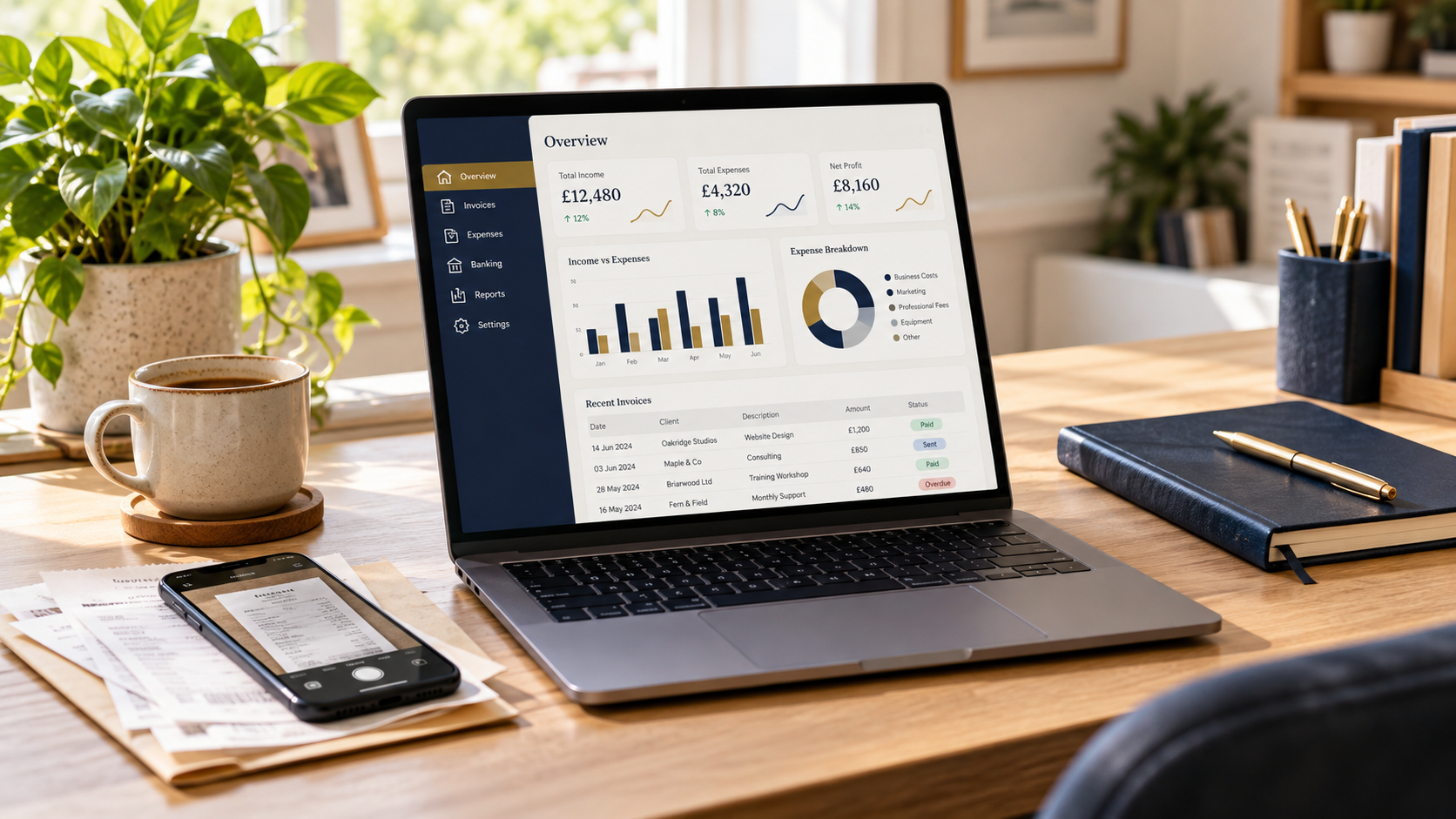
Accounting Software for Small Businesses Explained
Can accounting software make bookkeeping easier, prepare your tax return and reduce accountancy fees? We explain what to expect and how Craigerne Accountancy can help.
7 MIN READ | BOOKKEEPING & SOFTWARE
Accounting software can make it easier to keep on top of your business finances. It can reduce paperwork, save repeated typing and help you see what you are earning, spending and owed.
But how much does it actually do? Can it prepare your accounts and tax return? And will you still need an accountant?
This guide explains what to expect, what to check before subscribing and how Craigerne Accountancy can help you get started.
What can accounting software do
Most cloud accounting packages let you work through a web browser, with a mobile app for certain everyday tasks. Depending on the package and subscription, useful features include:
Bank feeds: import transactions from supported bank accounts.
Invoices: create and send invoices, track unpaid amounts and send reminders.
Receipts and expenses: upload documents or photograph receipts, with some tools extracting the details.
Bookkeeping: organise income and spending into categories and match payments to invoices.
Reports: show business income, costs and profit, plus money customers owe you.
Tax tools: help with estimates, VAT or other submissions where supported.
These features can reduce the amount of information you enter more than once. Availability, limits and extra charges vary, so check the specific plan.
Is it easy to use
You do not need to become an accountant to handle the everyday tasks. The aim is to learn a few useful routines: sending an invoice, uploading a receipt and checking what a bank transaction relates to.
There is still a learning curve, particularly at the start. Correct opening figures, sensible categories and the right settings make a difference.
At Craigerne Accountancy, we can help you set up your software and show you how to use the features relevant to your business. You can start with the basics and build confidence as you go.
Does it really make bookkeeping easier
It can, especially if you currently type transactions into a spreadsheet or sort through receipts at the end of the year.
For example, you might photograph a supplier receipt when you buy something, then match it to the payment when it appears through the bank feed. Keeping the document and transaction together makes them easier to find later.
However, imported transactions and suggested categories still need checking. A loan paid into your bank account should not be treated as sales income, and personal spending should not simply be recorded as a business expense.
Software reduces repetitive work, but the records still need to reflect what actually happened. A short, regular bookkeeping routine helps prevent a backlog.
Can it prepare my accounts and do the filings
Some packages can handle parts of this process, but bookkeeping, preparing annual accounts and filing tax returns are different functions.
Software can turn your bookkeeping records into reports showing income, expenses and profit. Those records provide the starting point for preparing your annual accounts and tax returns, reducing the need to enter the same information again.
Depending on the product and the features you subscribe to, it may also support submitting VAT returns, personal tax returns or company accounts and Corporation Tax returns to HMRC and Companies House. Some functions are built in, while others need an add-on or your accountant’s professional software. We can help you establish what is included and what additional support you need.
The key is to distinguish a report generated from your records from a completed set of accounts or a return that is ready to file. Missing transactions, the treatment of equipment purchases and expenses that are not allowable for tax can all affect the final figures.
Before filing, someone still needs to check that the records are complete and that any necessary accounting and tax adjustments have been made. At Craigerne Accountancy, we can agree who handles the bookkeeping, who reviews the figures and who prepares and submits each return.
Does it link to my Self Assessment
It can, but check exactly what the product supports.
It can help connect the two. Your bookkeeping records provide the business income and expense figures needed for your tax return, reducing repeated data entry. The exact process depends on whether you are within Making Tax Digital and which software you use.
Some filing tools are designed for accountants, while others can be used directly by business owners. Buying a bookkeeping subscription does not necessarily give you everything needed to complete your personal tax return. We can explain the appropriate route for your circumstances.
Your business records may only cover part of your tax position. Employment income, savings interest, dividends, property income and other relevant details may also need to be included. A business profit figure on a dashboard is not necessarily your final taxable profit or personal tax bill.
Craigerne Accountancy can help bring the information together and check that the chosen filing route covers your circumstances.
Can software automate Making Tax Digital filings
Yes, some software can automate submissions as well as prepare the figures.
Compatible software can use your bookkeeping records to prepare quarterly updates and support the annual tax submission, reducing manual entry. You or your accountant can manage the filing process through the appropriate software.
Automatic preparation is different from automatic submission. Some providers go further: FreeAgent, for example, can schedule quarterly submissions once configured. This does not extend to its year-end submissions. The available automation depends on the provider and settings.
The process should be agreed in advance: who keeps the records up to date, who checks them, whether approval is required before submission and who checks that HMRC has accepted it. An automated submission can still contain incomplete or incorrectly categorised information.
We can help configure a suitable process and explain which parts your chosen software automates.
If Making Tax Digital for Income Tax applies to you, compatible software is needed to maintain digital records, send quarterly updates and submit your annual tax return. Quarterly updates are summaries of business income and expenses, not separate tax returns.
You may use one suitable product or a combination of compatible tools. Spreadsheets can still play a role when connected through appropriate bridging software. The software must support the income sources and submissions you need. HMRC’s software guidance explains what to check.
We can help you check what applies to you and choose a workable approach. Our Making Tax Digital guide explains the wider requirements.
Could it reduce my accountancy fees
Possibly, if it reduces the work involved. Doing the everyday bookkeeping yourself can reduce the work you need to pay an accountant or bookkeeper to do. Complete, well-organised records can also help avoid additional charges for missing paperwork, correcting entries or reconstructing the books.
That principle applies whoever prepares your accounts. It does not guarantee that every accountant will reduce a fixed fee or include all support at no extra cost.
However, buying software does not automatically reduce your fees. The overall cost also depends on:
How much bookkeeping you do yourself.
The quality and completeness of your records.
The accounts, tax returns and advice you need.
Software subscriptions, setup, training and any ongoing support.
Poorly maintained software records can still take time to put right. The sensible comparison is the combined cost of software and professional support, alongside the time it saves you.
At Craigerne Accountancy, we can discuss the division of work and explain what is included in your fee before you commit.
Can Craigerne Accountancy access the software and help me
Yes. With your permission, Craigerne Accountancy can have a separate accountant or administrator login, where supported, with access appropriate to the work you have agreed.
A practical arrangement is for you to handle the core day-to-day work: raise invoices, upload receipts and check incoming bank transactions. Craigerne Accountancy can help you learn the process, resolve queries and review the records at agreed intervals.
Because you work from the same records, Craigerne Accountancy can look at the transaction you are asking about and help put it right. The aim is to build your confidence and maintain cleaner books throughout the year, reducing the amount of sorting out needed later.
You should use the software’s invitation and permissions settings rather than share your personal password. Software access and authorisation to act for you with HMRC are separate arrangements.
Access also does not mean someone is continuously monitoring your records. We would agree how often reviews take place and which tasks each of us will handle.
Which software providers are available and how much do they cost
Xero, FreeAgent, QuickBooks and Sage are among the options available, alongside other accounting packages and specialist tools. There is no single best choice for every business.
Many packages charge a monthly or annual subscription, with the cost depending on the features, number of users and level of functionality. Some providers offer free or lower-cost options for simpler needs, and software may sometimes be included with a qualifying business bank account.
Look beyond an introductory discount and consider the ongoing cost, VAT and any extras for payroll, receipt processing or tax filing. A lower-priced plan may be enough for a straightforward business, while more complex requirements can justify a fuller package.
Craigerne Accountancy can help you compare suitable providers and choose a package that fits your business, budget and confidence with technology. If you already use software, we can first discuss whether it meets your needs before recommending a change.
We can help you choose suitable software or make better use of the package you already have. Our advice is guided by what suits your business.
How do I choose the right package
Start with what your business needs. Consider your business structure, transaction volume, invoicing, VAT, payroll, stock and any other systems you use. Check that the software supports your bank and the filing requirements relevant to you.
Compare the ongoing subscription price as well as any introductory discount. Ask whether receipt processing, extra users, payroll, tax filings or other features cost more.
A trial can help you judge whether the everyday tasks feel manageable. It is also worth checking how you can export your records if you later change provider.
We can help you assess suitable options before you subscribe, so you pay for the features you need.
Can I keep using spreadsheets or switch from another system
The right approach depends on your reporting obligations and how you prefer to work. A simple spreadsheet may still suit some businesses, although applicable digital filing rules must be met.
If you are moving to new software, you do not necessarily need to re-enter every historic transaction. The amount to transfer depends on the changeover date, reporting needs and what the new system can import. Opening balances, unpaid invoices and outstanding bills need particular care.
We can help plan the changeover and check the starting figures, while making sure the records you need remain accessible.
How Craigerne Accountancy can help
At Craigerne Accountancy, we combine software certification with strong practical experience across a range of accounting packages. We can help you choose a suitable system, get set up and confidently manage your day-to-day bookkeeping.
We support small businesses in Peebles and the Scottish Borders, whether you are starting from scratch or looking to improve your existing bookkeeping routine.
Our aim is to get you comfortable with the everyday tasks, with professional support available where you need it. You remain involved in your finances while giving your accountant clearer, better-organised records.
Depending on the support you need, we can:
Help you choose a suitable package and subscription.
Set up your business details, opening figures and bookkeeping categories.
Help connect supported bank feeds and establish receipt and invoicing routines.
Show you how to handle the everyday tasks.
Use agreed accountant access to answer questions and help resolve problems.
Review your records and prepare accounts and tax submissions within your agreed service.
You may want to do most of the bookkeeping yourself, share the work with us or ask for more ongoing support. We can discuss an arrangement that suits your business and confidence with technology.
Thinking about accounting software, or already paying for a package you are struggling to use? Get in touch with Craigerne Accountancy to discuss your options and request a free quote.

Sole Trader or Limited Company – Which Is Right for Your Business ?
Should you operate as a sole trader or limited company? We explain the key tax, pension and practical differences — and why the right choice depends on your profits, personal income needs and future plans.
6 MIN READ | BUSINESS & TAX
One of the most common questions small business owners ask is:
The fundamental difference
But doesn't a limited company mean paying tax twice?
What choices does a company give you?
Salary – providing personal income, potentially subject to Income Tax and National Insurance.
Dividends – distributing post-Corporation-Tax profits, potentially subject to dividend tax but not National Insurance.
Pension contributions – the company can potentially make employer contributions directly into a director's pension.
Retaining profits – money not currently required personally may remain within the company.
Why can a company become more attractive as profits grow?
Can retaining profits help with future tax planning?
What about pensions?
What are the downsides of a limited company?
So, which is right for you?
The key takeaway
Let us run the numbers for you

Pensions for Small Business Owners: Limited Company vs Sole Trader
Should your business pay into your pension? This practical guide explains how pensions work for limited company directors and sole traders, the tax benefits, contribution limits and upcoming inheritance tax changes.
6 MIN READ | BUSINESS & TAX
Pensions for Small Business Owners: A Practical Tax Guide
For small business owners, pensions aren't just about saving for retirement. They can also be one of the most tax-efficient ways of using business profits to build long-term personal wealth.
But how pension contributions work — and the tax relief available — depends significantly on whether you run a limited company or operate as a sole trader.
In this guide, we answer some of the most common questions business owners have about pensions and explain where a little forward tax planning can make a real difference.
Why are pensions so tax-efficient?
Pensions benefit from several important tax advantages.
Depending on how contributions are made, you or your business may receive tax relief when money goes into the pension.
Once invested, money within a pension can generally grow without UK Income Tax or Capital Gains Tax being charged on investment returns.
The trade-off is that pension savings are designed for retirement, so you normally can't access the money until you reach the minimum pension age. Tax may also be payable when pension money is eventually withdrawn.
For business owners there is another important consideration:
How you put money into your pension can be just as important as how much you contribute.
I'm a limited company director. Should my company pay into my pension?
For many owner-directors, making an employer pension contribution directly from the company is an attractive option.
Rather than taking money out of the company personally and then contributing it to a pension, the company makes the pension contribution directly.
This can have two important tax advantages.
1. You don't need to extract the money personally first
If profits are extracted from a company as additional salary or dividends, personal tax and potentially National Insurance can arise.
A direct employer pension contribution avoids the need to extract that money personally before putting it into a pension.
2. The company can potentially receive Corporation Tax relief
Provided the pension contribution meets the relevant tax rules, including being incurred wholly and exclusively for the purposes of the company's trade, it will normally be deductible when calculating the company's taxable profits.
That can reduce the company's Corporation Tax bill.
For an owner-director who has accumulated surplus cash within a profitable company and wants to build their pension, this can therefore be a particularly tax-efficient route.
Can my company contribute more than my salary?
Potentially, yes.
This is an important point for many small company owners.
Owner-directors often take a combination of a relatively modest salary and dividends.
If you personally make a pension contribution, the amount on which you can receive tax relief is generally linked to your relevant UK earnings. Dividends aren't relevant earnings for this purpose.
Employer pension contributions work differently.
Your company can potentially make a pension contribution greater than your salary because employer contributions aren't subject to the same relevant-earnings restriction.
For example, a director receiving a relatively modest salary could potentially have their company make a substantially larger employer pension contribution.
The pension annual allowance and other pension rules still need to be considered.
This is one reason company pension contributions can be particularly useful for owner-managed businesses.
How much can my company pay into my pension?
The standard pension annual allowance is currently £60,000 per tax year.
The allowance looks at the total amount going into your pensions, including employer contributions.
However, £60,000 isn't necessarily an absolute ceiling.
You may be able to use unused annual allowance from the previous three tax years under the carry forward rules.
This can be particularly valuable for business owners.
Imagine you've concentrated on growing your business for several years and made relatively modest pension contributions. The business then has an especially profitable year and accumulates surplus cash.
Depending on your previous pension contributions and circumstances, carry forward could potentially allow the company to make a pension contribution significantly above the normal £60,000 annual allowance.
Different rules can apply to some higher earners and to people who have already flexibly accessed pension benefits, so available allowance should be checked before making a large contribution.
When should a limited company make the pension contribution?
Timing can matter.
Employer pension contributions are normally relieved for Corporation Tax purposes when they are actually paid, rather than simply when the company decides that it intends to make the contribution.
That makes pension planning particularly relevant before your company's financial year-end.
For example, if your company has had a profitable year and has surplus cash, you might consider:
How much cash does the business need?
How much do I need to extract personally?
Would I like to put more towards retirement?
Does the company have scope to make an employer pension contribution before year-end?
Looking at these questions together can be much more useful than considering the pension after the company's accounts have already been prepared.
I'm a sole trader. Does it work differently?
Yes.
A sole trader and their business aren't separate legal entities in the same way as a limited company and its owner.
You therefore don't have a company making an employer contribution for you.
Instead, a sole trader will normally make personal pension contributions.
Many personal pensions and SIPPs operate using a system called relief at source.
Suppose you want £10,000 invested into your pension.
You normally pay:
£8,000
Your pension provider claims:
£2,000 from HMRC
And the amount invested in your pension becomes:
£10,000
You don't normally have to contact HMRC to obtain that basic-rate relief — the pension provider claims it.
If you're entitled to additional tax relief because you pay tax at a higher rate, further relief may be available. Depending on your circumstances, this may need to be claimed from HMRC, including through your Self Assessment tax return.
How much can a sole trader contribute?
For personal contributions, tax relief is generally available on gross pension contributions up to 100% of your relevant UK earnings, subject to the pension rules and annual allowance.
For a sole trader, profits from the trade can therefore be important in determining the amount of tax-relieved personal contributions that can be made.
This creates another useful year-end planning opportunity.
If you've had a particularly profitable year, making a pension contribution could potentially both increase your retirement savings and improve your personal tax position.
Can I pay into a pension if my income is very low?
Yes, although the amount receiving tax relief can be restricted.
Even someone with little or no relevant UK earnings can normally make a £2,880 net contribution to a relief-at-source pension.
The pension provider can then claim £720 basic-rate tax relief from HMRC, resulting in:
£3,600 being invested in the pension.
This can be useful for people taking a break from work, working relatively few hours or earning only a small amount from their business.
Is a pension better than an ISA?
Not necessarily. They do different jobs.
With an ISA, you contribute money that has already been taxed. There is no tax relief when the money goes in, but investments can grow free of UK Income Tax and Capital Gains Tax and withdrawals are generally tax-free.
With a pension, there can be valuable tax relief when money is contributed, and investments can also grow in a tax-efficient environment.
But pension money is less accessible and some withdrawals may eventually be taxable.
For many business owners, the answer isn't pension or ISA.
It can be useful to have both:
Pension: long-term retirement savings with potentially significant upfront tax advantages.
ISA: tax-efficient investments that remain accessible when you need them.
The appropriate balance depends on your circumstances and financial objectives.
What happens to my pension when I die?
This is an area where the rules are changing.
Historically, pensions have often sat outside an individual's estate for Inheritance Tax purposes.
From 6 April 2027, most unused pension funds and pension death benefits will be brought within an individual's estate for Inheritance Tax purposes.
This doesn't remove the other tax advantages of pensions, but it does change one of the attractions pensions have historically had for estate planning.
For business owners with substantial pensions, property, investments or other assets, pensions should therefore increasingly be considered as part of their wider estate and retirement planning rather than automatically being viewed as outside their estate.
Does my pension affect whether I should be a sole trader or limited company?
Potentially — although pensions should normally be one consideration rather than the reason for choosing a particular business structure.
There are important differences between operating as a sole trader and through a limited company, including how profits are taxed, administrative requirements, legal responsibilities and how money can be taken from the business.
Pensions are another difference worth considering.
As a sole trader, pension contributions are normally made personally and the amount qualifying for tax relief is linked to your relevant UK earnings.
With a limited company, the company can potentially make employer pension contributions directly for a director. These aren't subject to the same relevant-earnings restriction and may also be deductible when calculating the company's taxable profits.
For someone intending to make substantial pension contributions over a number of years, this may therefore form part of the wider sole trader versus limited company calculation.
It shouldn't be considered in isolation. The right business structure depends on your profits, how much money you need personally, future plans and wider tax and commercial circumstances.
Related guide: Sole Trader vs Limited Company – Which Is Right for Your Business?
Pension or leave the money in my company?
This is often the more interesting question for an established business owner.
If your company has accumulated surplus cash, there are several possible uses for it.
You might:
retain the cash within the company;
reinvest it in the business;
extract some for personal spending or investment; or
contribute some to your pension.
A pension contribution can be extremely tax-efficient, but it also moves the money from an accessible company asset into a pension that you may not be able to access for many years.
The decision therefore isn't purely about achieving the lowest possible tax bill.
It should also consider the company's future cash requirements, your personal cash requirements and your longer-term plans.
When should a business owner review their pension?
Pension planning can be particularly worthwhile:
when deciding whether to operate as a sole trader or limited company;
before your company's financial year-end;
after an especially profitable year;
when cash is accumulating within your company;
when reviewing your salary and dividends;
when your income moves into a higher tax band;
if you haven't made significant pension contributions for several years;
when approaching retirement; or
when reviewing your wider estate and Inheritance Tax position.
The important point is that pension planning shouldn't sit completely separately from your business and tax planning.
How can Craigerne Accountancy help?
Pension planning for a business owner doesn't start with choosing a pension fund. There are often important business and tax decisions to make first.
At Craigerne Accountancy, we can help you consider pensions as part of your wider business and personal tax planning.
Choosing how to structure your business
If you're starting a business — or considering moving from sole trader to limited company — we can help you understand the financial and tax implications of the different structures.
Pensions can form part of that analysis.
We can look at your expected profits, how much income you need personally, your plans for the business and your pension objectives when considering whether operating as a sole trader or limited company may be appropriate.
Read our related guide: Sole Trader vs Limited Company – Which Is Right for Your Business?
For limited company owners
We can help you:
assess whether the company should make employer pension contributions;
estimate the Corporation Tax effect of a contribution;
consider pension contributions alongside salary and dividends;
look at the timing of contributions around your company's year-end;
consider the company's available profits and cash; and
understand the tax implications before money is extracted from the company.
For sole traders
We can help you:
understand how pension contributions affect your tax position;
identify whether additional pension tax relief may be available;
incorporate pension contributions into your Self Assessment tax planning; and
consider the effect of contributions when profits are particularly high.
Your accountant's role is different from that of a financial adviser. We can help with the business, accounting and tax implications of making pension contributions.
Where you need advice about which pension or investments to choose, or other regulated financial advice, we can work alongside your financial adviser.
Thinking about making a pension contribution?
If you're starting a business, reviewing its structure or considering putting a significant amount into your pension, it's worth looking at the tax position before making the decision.
Speak to Craigerne Accountancy and we can help you understand how pensions fit into the wider tax picture for you and your business.
This article provides general information about the tax treatment of pension contributions and is not personalised tax, pension or financial advice, nor a personal recommendation. Craigerne Accountancy does not advise on the suitability of particular pension products, pension providers, investments or investment strategies. Pension and tax rules depend on individual circumstances and may change over time. Where regulated financial advice is required, we recommend that you speak to an appropriately authorised financial adviser.
Self Assessment Tax Return Deadlines Explained (2026/27)
Confused about Self Assessment deadlines? This practical guide explains the key dates, who needs to file, how Payments on Account work, and how to avoid HMRC penalties and last-minute surprises.
4 MIN READ | PERSONAL TAX
Missing a Self Assessment deadline can lead to unnecessary penalties and interest from HMRC. The good news is that, with a little planning, it's easy to stay on top of your obligations.
Who Needs to Complete a Self Assessment Tax Return?
You may need to complete a Self Assessment tax return if you:
Are self-employed.
Receive rental income from property.
Have untaxed income.
Need to report Capital Gains Tax.
Receive certain investment or overseas income.
Are a partner in a business partnership.
Need to claim specific tax reliefs or allowances.
Have been asked by HMRC to complete a tax return.
Important: A high salary on its own no longer automatically means you need to complete a Self Assessment tax return. If all of your income is taxed through PAYE, you may not need to file a return unless HMRC requests one or you have other income to report.
If you're unsure whether you need to file, it's worth checking before the deadline to avoid potential penalties.
The Key Self Assessment Deadlines
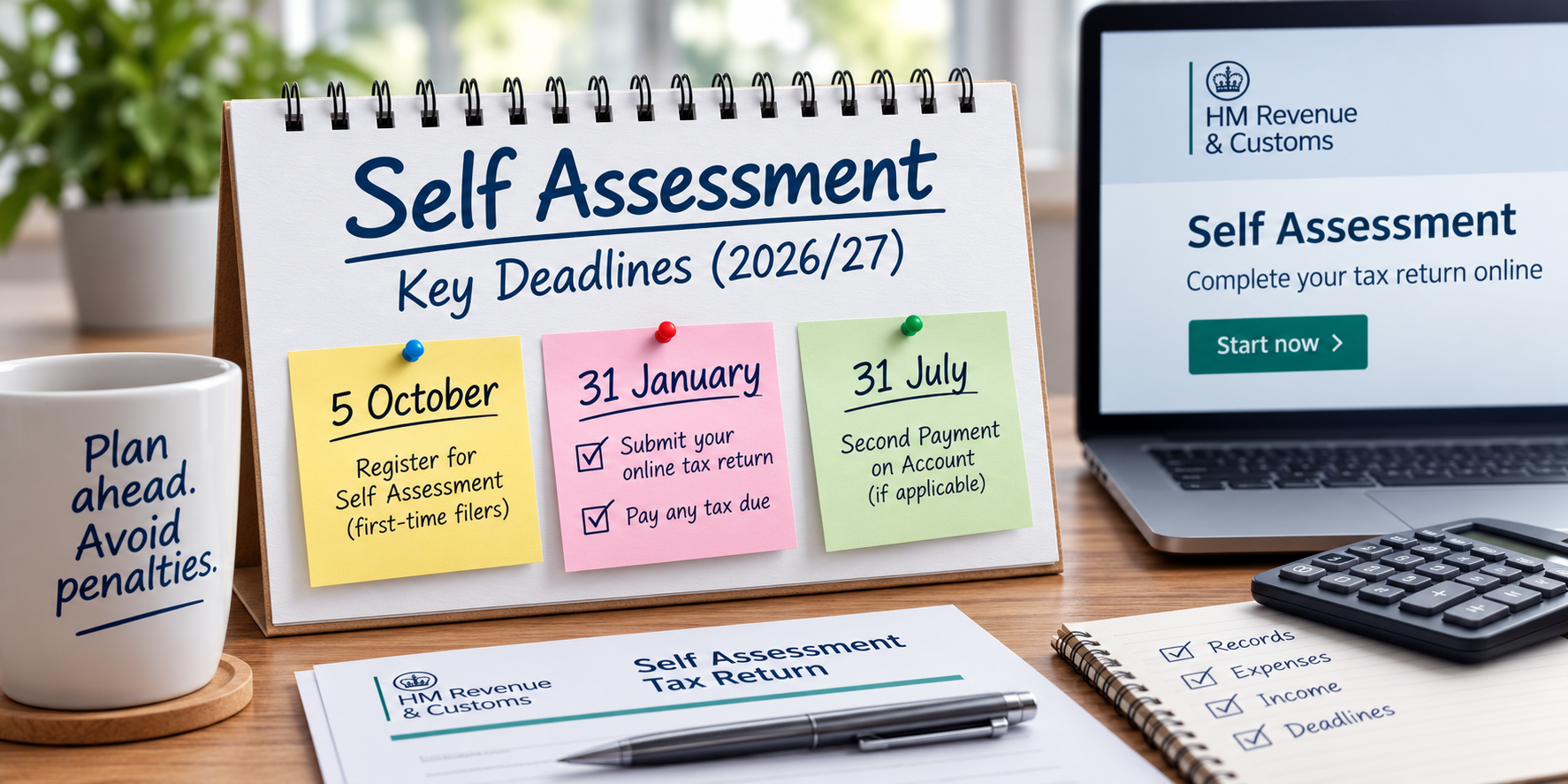
For most taxpayers, there are just three dates to remember. If you are completing a tax return for the tax year 6 April 2025 to 5 April 2026, your key deadlines are:
5 October 2026 – Register for Self Assessment (first-time filers only).
31 January 2027 – Submit your online tax return and pay any tax due for the 2025/26 tax year. This is also the deadline for your first Payment on Account for 2026/27 (if applicable).
31 July 2027 – Make your second Payment on Account (if applicable).
Most Self Assessment tax returns are now submitted online. A separate 31 October deadline applies only to paper tax returns. If you're eligible to have tax collected through your PAYE tax code, you'll normally need to file online by 30 December.
What Are Payments on Account?
Many people are surprised when their first Self Assessment tax bill is larger than expected.
This is because HMRC may ask you to make Payments on Account towards your next year's tax bill.
Who Do Payments on Account Apply To?
Payments on Account usually apply if:
Your Self Assessment tax bill is more than £1,000, and
Less than 80% of your tax has already been collected through PAYE or another source.
If your Self Assessment tax bill is £1,000 or less, or most of your tax has already been deducted before you receive it, you will not normally have to make Payments on Account.
A Simple Example
Imagine you've completed your 2025/26 Self Assessment tax return. The return calculates that you owe £8,000 in tax.
Because your tax bill is over £1,000, HMRC assumes you will earn a similar amount next year and will ask for payments in advance:
31 January 2027: Balancing Tax due for 2025/26 - £8,000
31 January 2027: First Payment on Account for 2026/27 - £4,000
Total due on 31 January 2027- £12,000
31 July 2027: Second Payment on Account for 2026/27 - £4,000
Although your tax return calculated a tax bill of £8,000 for the 2025/26 tax year, HMRC is also asking you to pay half of your estimated tax for the following year in advance.
When you later submit your 2026/27 tax return, HMRC compares the tax you've already paid in advance with the amount actually due:
If you've paid too much, you'll normally receive a refund or have the overpayment set against future tax.
If you've paid too little, you'll simply pay the remaining balance.
Can Payments on Account be reduced?
If you expect your tax bill to be lower than the previous year, you may be able to reduce your Payments on Account. Take care not to reduce them too far, as HMRC may charge interest if you underpay.
Craigerne Tip: We encourage clients to prepare their tax return well before January. Knowing your tax bill early gives you time to budget for any Payments on Account and avoids last-minute surprises.
What Happens If You Miss a Deadline?
Missing a Self Assessment deadline can quickly become costly. HMRC enforces a strict, escalating penalty regime for late filing and late payments—even if you ultimately owe no tax at all.
Here is exactly how the penalties stack up if you miss the 31 January deadline:
1 day late: An immediate £100 automatic penalty applies the moment you miss the midnight deadline.
3 months late: HMRC charges an additional £10 per day for up to 90 days, adding a maximum of £900 to your bill.
6 months late: A further penalty of 5% of the tax due or £300 (whichever is greater) is added.
12 months late: Another 5% of the tax due or £300 (whichever is greater) is applied. In serious cases, the fine can be up to 100% of the tax due.
Late Payment Penalties and Interest
Filing your tax return on time is only part of the process—you also need to pay any tax due by the deadline.
If payment is made late, HMRC will charge interest on the outstanding amount from the day after the payment deadline. Depending on your circumstances and which penalty regime applies, HMRC may also charge late-payment penalties if the tax remains unpaid.
If you're struggling to pay, it's important to contact HMRC as soon as possible. In many cases, agreeing a Time to Pay arrangement before penalties arise can help reduce or avoid some late-payment penalties.
What Information Will You Need?
Having your paperwork ready makes completing your tax return much easier.
Depending on your circumstances, you may need:
Employment income (P60 or P45).
Self-employment income and expenses.
Rental income and expenses.
Bank interest.
Dividend income.
Pension contributions.
Gift Aid donations.
Capital Gains information.
Keeping organised records throughout the year can save considerable time when your tax return is due.
Common Mistakes We See
Some of the most common issues include:
Leaving everything until January.
Forgetting to register for Self Assessment.
Missing allowable business expenses.
Forgetting rental or dividend income.
Losing receipts and records.
Underestimating the first tax bill because of Payments on Account.
Getting advice early can often save both tax and stress.
Top Tips
Register early if this is your first tax return.
Keep digital records throughout the year.
Don't wait until January to gather your paperwork.
Set money aside regularly for your tax bill.
How Craigerne Accountancy Can Help
At Craigerne Accountancy, we help individuals, landlords and business owners complete accurate Self Assessment tax returns on time.
We can help you:
Prepare and submit your tax return.
Claim all allowable expenses and tax reliefs.
Understand your tax bill before it's due.
Help you budget for Payments on Account.
Deal with HMRC on your behalf if required.
Whether it's your first tax return or you've been filing for years, we'll make the process straightforward, accurate and stress-free.
Making Tax Digital for Income Tax: What You Need to Know
Making Tax Digital (MTD) is changing how many self-employed individuals and landlords manage their tax affairs.
3 MIN READ | PERSONAL TAX
Making Tax Digital (MTD) for Income Tax is now being introduced by HMRC.
If you're self-employed or a landlord, it's important to understand whether the new rules apply to you and what you need to do before your start date.
The good news is that, with the right software and a little preparation, the transition is usually straightforward.
What is Making Tax Digital?
MTD is HMRC's programme to modernise the UK tax system.
Instead of keeping paper records and completing one annual Self Assessment tax return, affected taxpayers will:
• Keep digital accounting records.
• Use HMRC-compatible software.
• Submit quarterly updates to HMRC.
• Complete a Final Declaration after the end of the tax year.
The aim is to make tax reporting more accurate while giving taxpayers a better view of their finances throughout the year.
Who Needs to Comply?
MTD for Income Tax is being introduced in stages based on your total qualifying income from self-employment and property.
From April 2026: Individuals with qualifying income over £50,000.
From April 2027: Individuals with qualifying income over £30,000.
Expected from April 2028: Individuals with qualifying income over £20,000, subject to legislation.
What is qualifying income?
The MTD income threshold is based on your qualifying gross income from self-employment and property businesses before expenses are deducted. This includes UK property income and may also include overseas property or self-employment income if it forms part of your UK Income Tax reporting. Employment income, dividends and pension income do not count towards the threshold.
If you're unsure whether the rules apply to you, we're happy to help.
When Is My First MTD Submission Due?
If you join Making Tax Digital from 6 April 2026, your first quarterly reporting period covers: 6 April 2026 to 5 July 2026. Your first quarterly update must be submitted to HMRC by 7 August 2026, just over one month after the quarter end.
Other reporting period and submission deadlines are as follows:
Quarter 2: Period covered: 6 July to 5 October. Submission deadline: 7 November
Quarter 3: Period covered: 6 October to 5 January. Submission deadline: 7 February
Quarter 4. Period covered: 6 January to 5 April. Submission deadline: 7 May
After your fourth quarterly update, you'll complete a Final Declaration, which replaces much of the current Self Assessment reporting process. This is normally due by 31 January following the end of the tax year.
Note - these are the standard quarterly periods. Some businesses may instead use calendar quarters (1 April to 30 June etc.) depending on their software and accounting period.
Do I need to pay tax quarterly now?
No, quarterly updates do not mean you'll pay tax every three months.
They simply keep HMRC updated on your income and expenses. Your tax payment dates remain unchanged.
What Should You Do Now?
If you think MTD may apply to you, we recommend taking these simple steps.
1. Check your income
Work out your annual self-employment and rental income to see whether you exceed the relevant threshold.
2. Move to digital records
If you're still relying on paper records or spreadsheets, now is the ideal time to move to digital bookkeeping.
3. Choose compatible software
You'll need HMRC-compatible software to comply with MTD. Choosing the right software now will make the transition much easier.
4. Get everything ready before your deadline. Don't wait until your first quarterly submission is due.
Setting everything up in advance gives you time to become familiar with the software and avoids unnecessary stress.
Do I Need Accounting Software?
Yes. Most taxpayers affected by MTD will need HMRC-compatible accounting software.
While spreadsheets can still be used in certain circumstances, they generally need to be linked to compatible software to meet HMRC's digital requirements.
Cloud accounting software also offers several additional benefits:
• Keep your records organised throughout the year.
• See your income and expenses in real time.
• Reduce paperwork.
• Estimate your tax position earlier.
• Make year-end tax reporting much simpler.
How Craigerne Accountancy Can Help
Making Tax Digital doesn't have to be complicated.
At Craigerne Accountancy, we can help you:
• Confirm whether MTD applies to you.
• Calculate whether you meet the income thresholds.
• Recommend suitable accounting software.
• Set up your digital bookkeeping.
• Prepare and submit your quarterly updates.
• Complete your Final Declaration.
• Provide ongoing support throughout the year.
Whether you're self-employed, a landlord, or both, we'll ensure you stay compliant while keeping the process as straightforward as possible.
Get in touch today to make your transition to Making Tax Digital simple and stress-free.